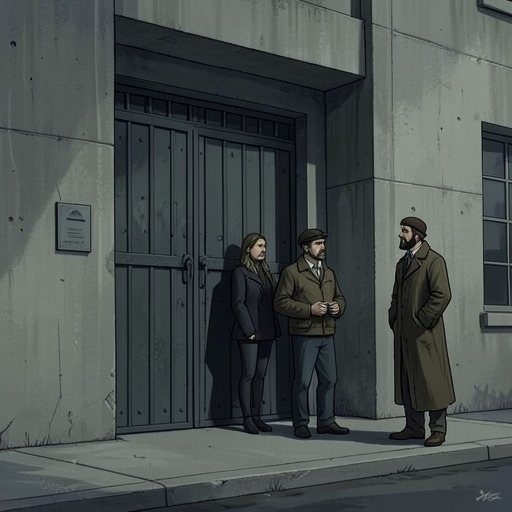
Triple Click Headquarters
Mr. & Mrs. SmithTriple Click Headquarters is the organization’s working office and a concealed military-style facility, where a target investigation gives way to an armed breach and a destructive escape. Its ordinary corporate surfaces mask secret panels, rocket launchers, and emergency measures designed to leave no evidence behind.
Office and Hidden Infrastructure
The headquarters’ operations room hums with machinery compared to well-tuned Jaguars waiting at a traffic light. Jane directs her team to establish the target’s full profile, authorizing phone taps, credit-card checks, and monitoring of civilian frequencies. The office is a center for surveillance and coordinated intelligence work, not merely a place to receive assignments.
That professional exterior conceals a prepared arsenal. During evacuation, team members shut down the computer system and gather paper files for an incinerator; Jasmine adds accelerant, and the records are destroyed. The organization’s plans extend far down the alphabet, but nearly all require that no paper, comma, or footprint remain. The insistence on erasure makes the office’s hidden military equipment part of a broader system of operational secrecy.
The Breach and Evacuation
The headquarters’ defenses are exposed when a small grenade drops through a ventilation opening and rolls across the floor. Its toy-like appearance briefly contrasts with its lethal function: Jane recognizes that it is not a joke, and John announces that she is dead. The attack transforms the surveillance center into a combat zone.
As the computers are shut down and records destroyed, the team opens secret panels in what look like ordinary office walls and removes rocket launchers from concealed compartments. They activate last-resort controls; explosions press the windows inward and scatter glass across the office floor. The sequence makes the building’s design legible through its emergency use: the office is equipped not only to fight, but to break open a route out.
Team members attach the launchers’ Kevlar lines to ceiling anchors, then fire grappling hooks carrying additional lines toward neighboring buildings. The escape depends on turning the headquarters’ own concealed fittings and weapons into a means of evacuation. Its carefully hidden infrastructure, initially invisible beneath the office facade, becomes the mechanism by which the team abandons the building.
John’s Approach and the Building’s Role
John reaches a new skyscraper rising more than eighty stories into the blue sky and checks the address written on a page from Jane’s notepad: the eighty-second floor. Jane realizes that he has deciphered the address she left at home and understands why he has come and what he intends to do. Watching surveillance footage of him trapped in an elevator between floors, she registers the immediate danger as well as his appearance in black.
The approach turns the headquarters into the destination of a conflict between spouses who have become opposing agents. Its position on the eighty-second floor emphasizes the distance between the ordinary domestic clue that led John there and the high-security workplace awaiting him. Within that setting, surveillance, concealed weapons, and escape engineering converge: the building is at once an intelligence office, a trap, and a launch point for flight.